Short Luteal Phase and Low Progesterone: What it means for fertility ( and how to fix it naturally)
If you’ve ever found yourself spotting before your period, noticing your cycles are on the shorter side, or wondering why you can get pregnant but can’t seem to stay pregnant, there’s a good chance your body is trying to tell you something important.
And one of the most common—but often overlooked—reasons behind this is something called a short luteal phase, usually driven by low progesterone.
Now I know that might sound a little technical or intimidating at first, but stay with me. This is one of those topics that, once you understand it, suddenly makes so many things click. And more importantly, it gives you direction instead of leaving you stuck guessing.
Because this isn’t random. And it’s not something you’re just stuck with forever.
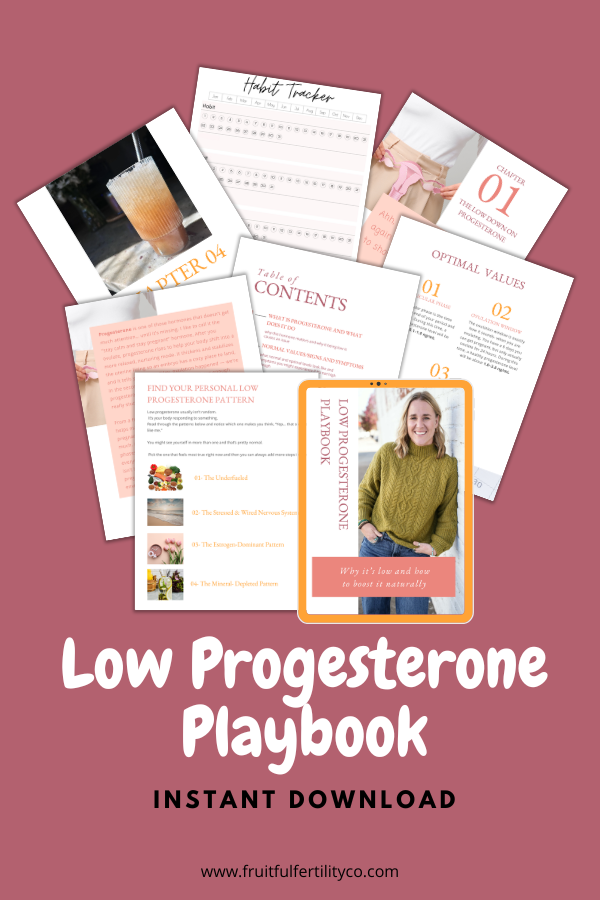
Grab the Low Progesterone Playbook
Your instant download to find answers for your low progesterone and a plan to improve it naturally!
What a Luteal Phase Actually Is (Without the Textbook Confusion)
Let’s break this down in a way that actually makes sense.
Your cycle isn’t just your period—it’s a full process your body moves through every single month. From the first day of your period to the first day of your next one, that entire span is your cycle. And within that, there are a few different phases your body moves through.
The one we’re focusing on here is the luteal phase, which happens after ovulation and before your next period begins.
This phase is incredibly important because it’s when your body is essentially preparing for pregnancy. It’s creating a supportive environment, building up the uterine lining, and getting everything ready in case a fertilized egg needs somewhere to implant and grow.
In a healthy cycle, this phase usually lasts somewhere between 11 to 14 days. That window gives your body enough time to support implantation and begin early pregnancy.
What It Means to Have a Short Luteal Phase
A short luteal phase simply means that this window is too short—typically less than 10 days .
And while that might not sound like a big difference, those few missing days matter more than most women realize.
Because what’s happening is that your body starts preparing for a period too soon. The uterine lining begins to shed before a fertilized egg has had enough time to fully implant and signal that pregnancy has begun.
It’s not that ovulation isn’t happening. It’s not that fertilization can’t happen.
It’s that the environment isn’t being sustained long enough.
That’s why women with a short luteal phase often notice things like spotting before their period, cycles shorter than 26 days, or even repeated early losses or chemical pregnancies .
And if you’ve experienced that, I want you to hear this clearly: your body isn’t failing you. It’s responding to something.
Why This Matters More Than You’ve Probably Been Told
One of the most frustrating things about fertility struggles is when everything looks like it should be working.
You’re ovulating.
You’re tracking.
You’re timing things correctly.
And yet, the outcome you’re hoping for just isn’t happening.
This is where the luteal phase becomes so important.
Implantation isn’t an instant event—it takes time. Your body needs a stable, supportive environment for several days so that a fertilized egg can attach, settle in, and begin communicating with your body.
If that window closes too early, the process gets interrupted.
And that’s why a short luteal phase can feel like this invisible roadblock—because everything else might look “normal,” but this one piece is quietly cutting the process short.
If you want to listen to this info in podcast style- check out the Fruitful Fertiltiy Co Podcast
The Real Root of the Problem: Low Progesterone
At the center of almost every short luteal phase is one key issue: low progesterone.
Progesterone is the hormone responsible for maintaining the uterine lining after ovulation. It’s what keeps everything stable, supportive, and ready for pregnancy.
Without enough progesterone, the body can’t sustain that environment.
And the best way I’ve ever heard this explained is through a simple visual.
Imagine a bowling ball sitting in a grocery bag.
The bowling ball represents a potential pregnancy. The bag represents your progesterone.
If the bag is thin or weak, it’s not going to hold that weight for very long—it’s going to break.
But if the bag is strong and sturdy, it can support what it’s holding.
That’s exactly what progesterone does. It’s the support system that allows pregnancy to take hold and stay.
Why Your Progesterone Might Be Low in the First Place
This is where things start to get more personal, because low progesterone isn’t random. It’s usually a symptom of something deeper going on in your body.
One of the most common causes is weak or delayed ovulation. After ovulation, your body forms something called the corpus luteum, which is responsible for producing progesterone. If ovulation isn’t strong or is delayed—maybe due to stress, illness, or travel—then that progesterone signal isn’t as strong as it needs to be .
Stress itself is another major factor. Your body is designed to prioritize survival over reproduction, so when stress levels are high and cortisol is elevated, your body will divert resources away from making progesterone. It’s not that your body is working against you—it’s actually trying to protect you.
There’s also the foundational piece that often gets overlooked: minerals. Your body needs the right building blocks to create hormones, and minerals act like the spark plugs that keep everything running. When those are out of balance, hormone production—including progesterone—can suffer .
And then there’s hormone balance itself. Estrogen and progesterone are meant to work together, but when estrogen is too high—a state often referred to as estrogen dominance—it can suppress progesterone levels. This can be influenced by things like environmental toxins, underlying conditions, or how well your body is able to process and clear hormones.
The important thing to understand is that these factors are often connected. One imbalance can lead to another, which is why it can feel confusing when you’re trying to figure out what’s going on.
When we go in, we address what is causing the low progesterone, we strengthen our progesterone levels, we see that luteal phase get longer
So… Can You Actually Fix a Short Luteal Phase?
This is the part I really want you to hear:
Yes, you can.
A short luteal phase is not a life sentence. It’s not something you’re just stuck managing forever. It’s a signal pointing you toward an imbalance that can be addressed.
But the key is not guessing.
Because trying random supplements or strategies without understanding why your progesterone is low is what keeps so many women stuck.
What actually works is identifying your pattern—what’s driving your imbalance—and starting there.
For some women, that means supporting ovulation more intentionally. For others, it means addressing chronic stress patterns that are keeping cortisol elevated. For others, it’s rebuilding mineral levels or working on hormone balance from the ground up.
When you address the root cause, progesterone improves. And when progesterone improves, the luteal phase lengthens.
And that changes everything.
Your Body Isn’t Broken—It’s Communicating
If you’re dealing with a short luteal phase, it’s easy to feel frustrated or discouraged. It can feel like your body is working against you.
But the truth is, your body is doing exactly what it’s designed to do—it’s responding to the environment and inputs it’s been given.
A short luteal phase is communication. It’s your body saying, “Something is off, and I need support here.”
And when you listen to that and respond appropriately, your body is incredibly capable of shifting.
If You’re Ready for Real Answers
If you’re tired of guessing and want to understand exactly what’s driving your low progesterone, this is where having a clear roadmap matters.
That’s exactly why I created the Low Progesterone Playbook—to help you identify your specific pattern and know what to do next, instead of trying everything and hoping something sticks.
Because once you have clarity, everything gets simpler.
And you can finally move forward with confidence instead of confusion.
A short luteal phase is most commonly caused by low progesterone, which can result from weak ovulation, high stress (cortisol imbalance), mineral deficiencies, or estrogen dominance.
You can lengthen your luteal phase by improving progesterone production through supporting ovulation, reducing stress, balancing minerals, and addressing hormone imbalances like estrogen dominance. You can follow the prompts in The Low Progesterone Playbook or work with Tori directly for more support and answers.
Yes, it’s possible to get pregnant with a short luteal phase, but it can make implantation and sustaining pregnancy more difficult if progesterone levels are too low.
A healthy luteal phase is typically 11–14 days, and anything shorter than 10 days is generally considered too short to reliably support implantation and early pregnancy.