Can you get pregnant with low progesterone? Here’s the truth
Can you get pregnant with low progesterone? And what can I do about it? 👇🏼
You’ve been spotting before your period. Your cycles are shorter than they used to be. Maybe someone mentioned low progesterone, or maybe you figured it out yourself from hours of late-night Googling. And now the question you can’t stop thinking about is: can you even get pregnant like this?
I want to give you two answers — because honestly, you deserve both of them.
The first answer is yes. Absolutely yes. I have had a front-row seat to God doing things that make zero sense on paper. Women with no periods. Women who are bleeding constantly. Women who were told their chances were essentially gone. And then — a baby. I’ve seen too much to believe that anyone is fully out when it comes to getting pregnant naturally. So spiritually, my answer is always yes.
The second answer is also yes — and let’s give your body every possible advantage. Because low progesterone is your body sending up a flare. It’s telling you something is off. And the good news is, that something is very much within your control to address.
Let’s talk about what’s actually going on.
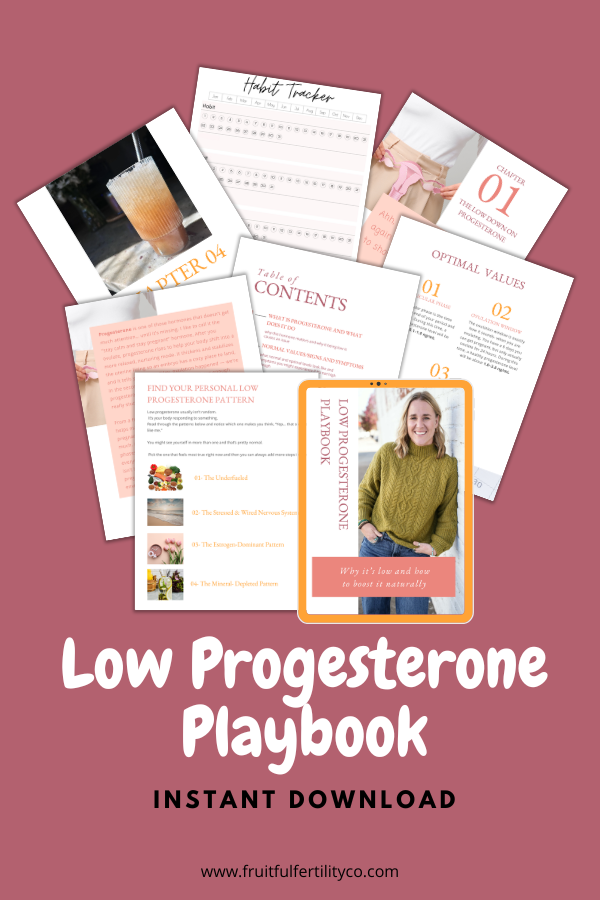
Grab the low progesterone playbook
Ready for a step by step plan to boost progesterone naturally? Grab The Low Progesteroen Playbook and find your pattern and your plan today!
Why do you have low progesterone in the first place?
Here’s the thing nobody tells you clearly: low progesterone is almost always a stress problem.
And before you roll your eyes — I know. You’re tired of being told to “just relax.” That advice makes you want to flip a table. So let me be more specific about what stress actually means in this context, because it is probably not what you think.
When cortisol is high, progesterone suffers. They are essentially competing for first place in your body, and if cortisol is winning, progesterone is not. Your body will always prioritize survival over reproduction. That’s just biology.
But “stress” is not just a hard day at work or feeling overwhelmed. In your body, stress can look like:
- Blood sugar dysregulation — the kind that’s invisible, that you’d never know was happening without looking for it
- Mineral depletion — your body simply doesn’t have enough fuel on board to produce adequate progesterone
- Subconscious limiting beliefs — the thoughts you’ve been carrying since childhood about whether you’re worthy, whether this is for you, whether it’ll ever happen. These are not just emotional. They have a physiological impact on your cortisol levels.
- Lifestyle stressors — sleep deprivation, overexercising, under-eating, too much caffeine, not enough rest
So when I say stress is at the root of low progesterone, I mean all of the above. The job is to find your specific stressor (and hint hint you can do this with the Low Progesterone Playbook) — because it’s probably more than one, and it’s probably not the most obvious thing.
The signs your progesterone is low
If you’re not sure whether low progesterone is actually your issue, here’s what to look for:
- Spotting in the days before your period starts
- Cycles shorter than 26 days
- Breast tenderness in the week before your period
- A luteal phase (the time between ovulation and your period) that feels too short
- Difficulty staying pregnant even when conception happens
Sound familiar? Then keep reading because this post is for you.
3 Ways to Boost Progesterone Naturally To Get You Started
1. Identify Your Stressor — All of Them
This is the foundational step and I won’t let you skip it. In my programs, I walk clients through what I call a stress audit — going through every area of life, naming the stressors, and coming up with one or two real ideas for minimizing or managing each one.
Some stressors you can eliminate. Some you can only manage. But you can’t address what you haven’t named.
Here’s how to start: grab a piece of paper and write down every area of your life — work, relationships, finances, health, faith, family. Under each one, list what’s actively draining you. Then ask yourself: what’s one thing I could do to lighten this load, even a little?
This is also exactly what I’m listening for when I’m on a first call with a new client. I’m reading between the lines. I’m asking about childhood, about current work situations, about what they’re not saying. Because often the stressor hiding in plain sight is the one that’s been running the show for years.
2. Try Rise and Source — and Give It at Least 90 Days
I want to share some numbers with you, because I think they matter.
Over the last two years, I tracked every client and customer who ordered Rise and Source through me. Of everyone who placed an order — any order — 29% became pregnant. That is the same success rate as a single round of IVF. With no medications, no invasive procedures, and a fraction of the cost.
Then I looked at everyone who took Rise and Source for at least three months. That number jumped to 40%.
And for everyone who took it for five months or more? 57%. More than half.
These are not statistics from a company brochure. These are my clients. Women I have worked with. Numbers I tracked myself.
The thing I see Rise and Source do most consistently is stop the pre-period spotting and lengthen short cycles. I know this firsthand — I had a 24-day cycle with spotting and breast tenderness before my period. After two months on Rise and Source, my cycle lengthened to 28-29 days, the spotting stopped completely, and it has not come back. I’ve been taking it for over a year now. My period actually sneaks up on me now because I don’t have sore breasts to warn me it’s coming.
One important note: if you haven’t given something a full 90 days, you haven’t truly tried it. That’s how long it takes to see real changes in egg quality, cycle health, and hormone balance. If you’ve “tried everything” but nothing for 90 days — you haven’t tried it yet.
3. Go to Bed Earlier
I know. I know it sounds too simple. But stay with me.
Cortisol resets during sleep. If you are consistently going to bed at 11, midnight, or later — and getting up early — your body is not getting the reset it needs. And if cortisol can’t reset, it stays elevated. And if cortisol stays elevated, progesterone stays low.
This is the single most common piece of homework I give my one-on-one clients while we wait for their HTMA test results to come back: go to bed one hour earlier.
If you’re currently going to bed at 11, move it to 10. If 10 feels impossible because you’re not tired, you need to start preparing your body earlier in the evening.
Here’s what that looks like in practice:
- 6:30 PM — Start dimming the lights. Turn off overhead lights, switch to lamps. This signals to your brain that the sun is going down and it’s time to wind down.
- Evening — Put on blue light blocking glasses if you’re watching TV or scrolling your phone
- Before bed — Swap screen time for a book when you can. (I’m a huge reader — a good romanticé over Netflix any night.)
- Afternoon — Cut caffeine by 2-3 PM so it’s not interfering with your ability to fall asleep
You don’t have to be perfect. Some nights you’ll watch Netflix until you fall asleep. That’s fine. Progress over perfection, always. But most nights, even small changes to your evening routine will start moving the needle on your cortisol — and therefore your progesterone.
So — Can You Get Pregnant with Low Progesterone?
Yes. God can do anything, and I have seen Him do it.
And you deserve to go into this with your body as supported as possible. Low progesterone is not a life sentence. It is a signal. And when you learn to read it, it becomes one of the most actionable things you can work on.
If you want to listen to this info in podcast style- check out episode 138 on Fruitful Fertiltiy Co Podcast
FAQ- Can I get pregnant with low progesterone?
Frequently Asked Questions
Can low progesterone prevent pregnancy? Low progesterone can make it harder to conceive and harder to sustain a pregnancy, especially in the early weeks. But it is not an automatic barrier. Addressing the root causes — stress, sleep, minerals — can improve progesterone levels naturally and meaningfully improve your chances.
What are the signs of low progesterone? The most common signs are spotting before your period starts, cycles shorter than 26 days, breast tenderness in the week before your period, and a short luteal phase. If several of these sound familiar, low progesterone is likely worth investigating.
How long does it take to raise progesterone naturally? Give it a minimum of 90 days. Real changes in hormone balance, egg quality, and cycle health take time. If you’ve tried something for less than three months, you haven’t given it a fair chance.
Does stress really cause low progesterone? Yes — and not just the emotional kind. Blood sugar dysregulation, mineral depletion, poor sleep, and even subconscious limiting beliefs all raise cortisol, which competes directly with progesterone. Addressing your specific stressors is the first and most important step.
What is the best natural supplement for low progesterone? I’ve seen the most consistent results with Rise and Source, particularly for stopping pre-period spotting and lengthening short cycles. Based on my own client data, the pregnancy rates for women who take it consistently for 3-5+ months are striking — comparable to or better than IVF success rates.
You are not behind. You are right on time!
If You’re Ready for Real Answers
It’s time for a game plan and that’s exaclty what the Low Progesterone Playbook will give you. Grabs yours and get started today!
XO, Tori